Tuesday, May 5, 2009

Universal Health Care During Obama’s First Term?


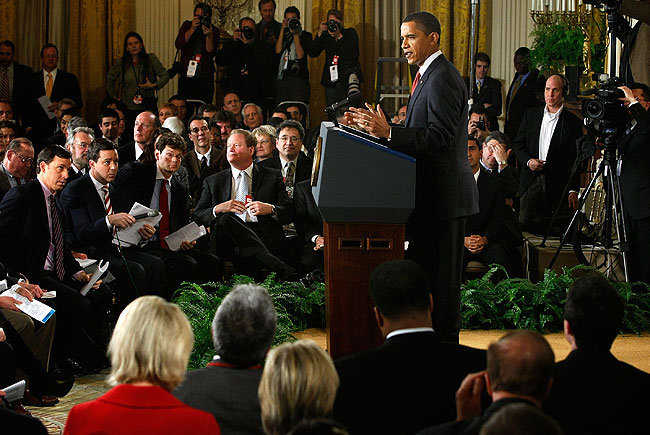
David Wessel, in his article “Moment Is Ripe for President to Fix Health Care,” from April 30ths Wall Street Journal, states that it appears that Obama is aggressively developing a health care plan. Wessel believes that there are four reasons that the time is right for a successful new health care plan. Unlike 1994 when Clinton presented his Health Security Act, there has been a significant downturn in the economy with an increase in the number of uninsured Americans and an increase in the cost of health care so that it now is approximately 17.6% of the U.S.’s spending. Thus, the general public is unhappy with “the status quo.” Next, Obama’s White House team has learned from Clinton’s mistakes, that his plan cannot be complicated and complex. Third, the Democrats have a majority in congress and appear to be united in their support of health care legislation to provide coverage for the American people. Finally, “the price tag” to fund health care does not seem to be such a significant issue anymore. Compared to the cost of the bank bailout, more than 750 billion, funding health care now seems to be doable.

Do you think Obama will present a new health plan by the end of 2009? If so, do you think it will pass congress?
How will the United States pay for all these expensive plans and bailouts?

Sunday, April 26, 2009

Health Care for the Poor and Uninsured


As I have been working on my junior theme, “Why doesn’t the United States have a universal health care plan that provides affordable access to all its citizens?,” I came across an interesting article in the Chicago Tribune called “Are hospitals passing off their low-profit patients?” The authors report that patients are not getting fully treated at nonprofit hospitals and are sending them on to Cook County’s Stroger Hospital. Despite nonprofit hospitals receiving millions of dollars in tax breaks and benefits for helping the uninsured, these hospitals are sending the patients to the already over-crowded Stroger Hospital. Unlike a private hospital, Stroger Hospital acts like a “safety net for the poor and uninsured,” but the hospital is struggling financially.

How do we solve the health care crisis? Wouldn’t a universal health care system help pave the way?

Thursday, April 23, 2009

REVISED INTRO!

“Of all forms of inequality, injustice in health care is the most shocking and inhumane,” Dr. Martin Luther King, Jr. once remarked (“About”). For decades, health care has been a main topic in elections and a major concern for all Americans. Every attempt for the United States to enact a health care reform plan that would provide universal coverage has failed (Quadagno 201). In a nation that spends sixteen percent of its wealth on medical care (Cohn 225), why can we not come up with a successful universal health care system? Health care needs to be treated as a right, not a privilege, and work needs to be done to provide affordable health care to all American citizens. Why is universal health coverage so important? There are 50 million Americans without incurance (Moore). Without coverage people do not have access to healthcare. Uninsured Americans tend to be diagnosed with later-stage tumors and do not receive preventative care (Cohn 23). It is estimated that 18 thousand Americans will die because they do not have unsurance (Moore). Throughout the history of the United States, there have been numerous failed attempts and only a few incomplete successes in providing universal health care due to the opinions and influence of propaganda, lobbyists, special interest groups, political groups and the public. A clear understanding of the reason for these failures may allow current advocates of universal health care to devise a plan that is successful in the United States.
Is the map easier to follow?

Sunday, April 19, 2009

“Harry and Louise” Influence Public Opinion in 1993-94.

“Having choices we don’t like is no choice at all!” exclaims Louise in the 1993 TV advertisement funded by the Health Insurance Association of America (HIAA) in response to President Clinton’s Health Security Act of 1993. The HIAA is a lobbying group for the Health Insurance Industry that felt threatened by Clinton’s Plan. A study by Goldsteen et al., published in Journal of Health Politics, reveals that the HIAA felt that the public was embracing Clinton’s Plan and mounted “commercial-style mass media campaigns” to turn public opinion against the proposed healthcare reform. This campaign was successful in inciting “Fear” of the government controlling our access to health care. Along with oppositions from other special interest groups, uncompromising Republicans, and complacent Americans, Clinton’s Plan failed.

Do you have concerns about allowing the U.S. Government taking over the health care industry and creating a single-payer system? In these times of economic troubles, would a single-payer plan that does away with business like Health Insurance Companies and HMOs further jeopardize our countries economic recovery or is it the way to go?

Sunday, April 12, 2009

Junior Theme Intro:

Introduction Paragraph:


Dr. Martin Luther King, Jr. once remarked that “Of all forms of inequality, injustice in health care is the most shocking and inhumane,” (Healthcare-Now! 3). For decades, health care has been a main topic in elections and a major concern for all Americans. Every attempt for the United States to enact a health care reform plan that would provide universal coverage has failed (Quadagmo 201). In a nation that spends sixteen percent of its wealth on medical care (Cohn 225), why can we not come up with a successful universal health care system? Health care needs to be treated as a right, not a privilege, and work needs to be done to provide affordable health care to all American citizens. This proposal seems simplistic, however throughout the history of our country there have been numerous failed attempts and only a few limited incomplete successes. We need to learn from the outcomes of these attempts, along with the successful systems working in other countries, in order to create a plan in which every American has access to health insurance.


*Please comment on what you believe I am planning on talking about in the body paragraphs of my paper, aka the map. I am unsure if this is clear enough. Also, does the beginning flow together connecting my grabber, background, and question, to my thesis and map?

Sunday, April 5, 2009

Why Don’t Americans Have Universal Health Care? Why is Health Care treated as a Privilege, Not a Right?


My Junior Theme focuses on the United States’ Health Care Crisis. As I was reading an article that I found on the CQ Researcher Online, I was stunned to find out that in the year 2007 about 45 million Americans lacked health insurance. Incredible, devastating stories of average Americans being unable to afford their medical care or obtain health insurance are told by Jonathan Cohn in his book Sick. Health insurance was one of the main issues throughout the recent presidential campaign and it has been a problem throughout history. My question is: Why don’t Americans have universal health care? And, why is health care treated as a privilege, not a right?

Do you think it is the right of every American citizen to have health care?
Should health care be provided by employers or the government?

Monday, March 30, 2009

Is There Justice?


I was shocked to read the headline in Jeff Coen’s article, “He Killed 14 People. He got 12 Years,” from the March 27th in Chicago Tribune. Nicholas Calabrese, a mob hit man, killed 14 people over the years and because he is cooperating with police officials will only receive a 12 year sentence. In fact, since he has been in jail since 2002, he will only have about 4 more years to serve. Families of the victims were outraged. However, without Calabrese’s testimony, mob bosses such as Joseph Lombardo and James Marcello and their “enforcers” Paul Schiro and Anthony “Twan” Doyle would be free. In a companion article by John Kass, “Leniency to Calabrese vs. mob and its justice,” Kass suggests that the “fear” or the mob getting back at him for informing on them will be punishment enough.

What do you think should be the policy on murderers who cooperate with officials? Should they get a lighter sentence in order to encourage others to come forward and cooperate? Is the “Fear” of retribution enough of a punishment?